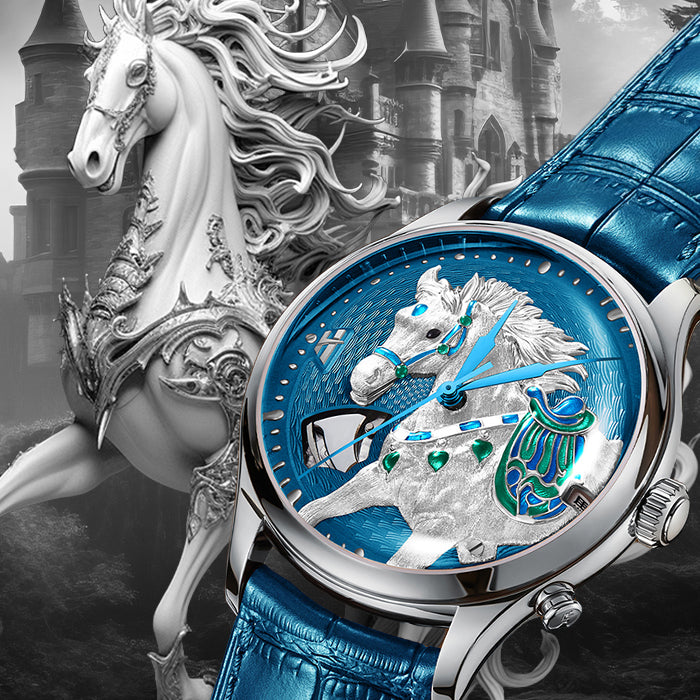

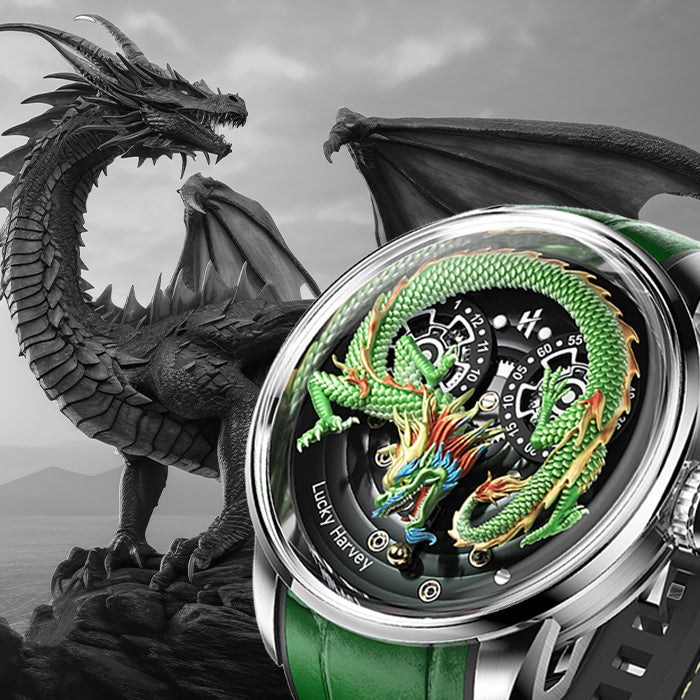

The chiming automaton horse watch is the most mechanically ambitious thing Lucky Harvey makes. It also generates more questions than any other piece in the catalog: how does the horse move, what makes the chime sound, what powers the animation, and how does any of this fit into a 42 mm case? This article opens the watch up — figuratively — and walks through what's actually happening every time it strikes the hour.
The Three Systems
Inside the case there are three separate mechanical systems working in close coordination.
The first is the timekeeping movement itself — a standard automatic caliber with a balance wheel, mainspring, gear train, and rotor. This is what tells time and what your wrist motion winds. It's also the source of energy for the other two systems.
The second is the chiming module. It has its own small mainspring, separate from the timekeeping mainspring, and a hammer-and-gong assembly that strikes the hour. The chime is not driven directly by the gear train; instead, the gear train releases the chime mainspring at the top of every hour, and the chime mainspring drives the hammer.
The third is the animation module — the part that makes the horse gallop. It has a cam, a set of levers, and rods that push up through the dial to the figure on the surface. The animation module shares a trigger with the chime: when the chime fires, the animation fires at the same instant.
The Hammer-and-Gong System
The hammer is a small tuned steel arm with a polished striking face. The gong is a circular wire of hardened steel coiled around the inside perimeter of the case, attached at one point so it can vibrate freely. When the hammer strikes the gong, the gong rings — the same way a struck tuning fork or a bell rings — and the case acts as a resonant chamber to amplify the sound.
The pitch of the chime depends on three things: the diameter of the gong wire, the material of the case (titanium and gold ring more clearly than steel), and the precise angle and force of the hammer strike. Lucky Harvey's titanium case rings noticeably brighter and longer than the steel version of the same watch — about half a second of audible decay versus a fraction of that in steel. This is one of the reasons the titanium edition exists.
The hammer is driven by a rack-and-snail mechanism — the same architecture that has powered chiming watches since the 1680s. A small wheel rotates once per hour and presents the hammer with the correct number of strike impulses. At 1 o'clock, one strike. At 12, twelve. The mechanism resets automatically after each hour.
The Animation Cam
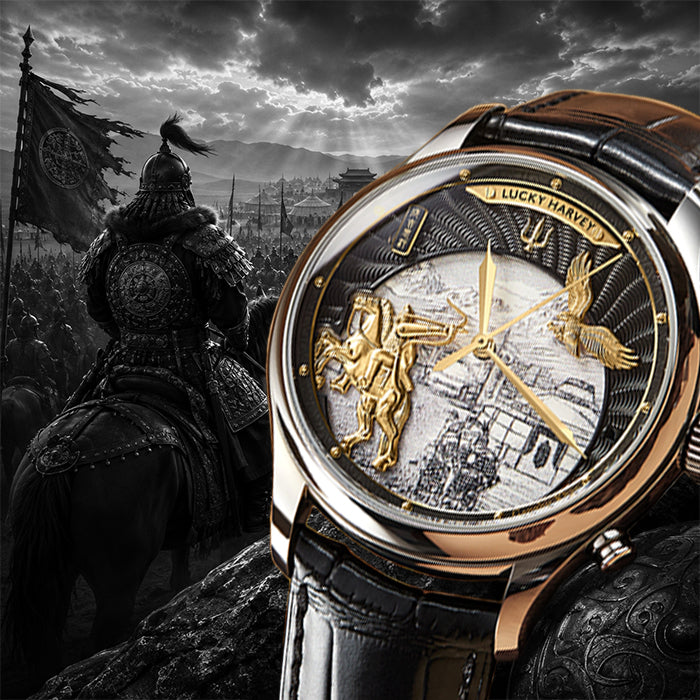
The horse animation is the most visually dramatic part of the watch and mechanically the most modern element. A small cam — a non-circular wheel with a sculpted profile — sits underneath the dial, connected by levers to the rods that push up through small holes in the dial to the figure on top.
When the chime fires, the cam is released and rotates through one full turn over the course of three to four seconds. As it rotates, the sculpted profile of the cam pushes the rods up and down in a specific sequence — first the back legs, then the front legs, then the head, then back to neutral. The pattern of rises and falls is what produces the galloping motion. A well-cut cam produces motion that feels organic; a poorly cut one looks jerky.
The cam is the single most labor-intensive component in the watch. It's milled from hardened steel and then hand-finished to a precise profile. Lucky Harvey's animation cam goes through twelve quality-control inspections before assembly because a cam profile that's even fractionally off will produce visibly wrong motion.
Power Reserve and How It Works
Two separate mainsprings live in this watch. The main timekeeping mainspring stores enough energy for about 42 hours of continuous running. The animation mainspring is much smaller and stores enough energy for roughly fifty animation cycles before it needs to be wound back up.
Both mainsprings are wound automatically by the rotor as your wrist moves, but they wind at different rates. The main mainspring fills first, then the rotor diverts excess energy to the animation mainspring. If you wear the watch daily, you'll never notice the difference — both stay topped up. If you wear it intermittently, the animation mainspring may run dry before the timekeeping mainspring does, in which case the chime still works but the horse stops moving until the animation spring is rewound.
Servicing
A chiming automaton watch needs more attention than a regular automatic. Lucky Harvey recommends a full service every four years, which involves disassembly of all three modules, cleaning, lubrication, cam inspection, hammer alignment, and gong tension adjustment. Service typically takes two to three weeks at an authorized center and costs more than a basic automatic service because of the additional complexity. This is the cost of owning a complicated mechanical watch and is something to budget for at purchase, not after.
Why It Costs What It Costs
Every additional moving part in a mechanical watch multiplies the assembly time. A standard automatic might have 130 parts. The Lucky Harvey chiming automaton has over 280. Each additional part has to be designed, machined, finished, and assembled without disturbing the timekeeping function. The assembly alone takes an experienced watchmaker six to ten times longer than a standard automatic. Combined with the cam-cutting precision and the hand-tuning of the gong, the labor cost of one of these watches is several times that of a standard piece in the same case.
The result is a watch that sits below $2,400 and contains complications that cost five figures from Swiss makers. That gap is what the Chinese watchmaking renaissance has made possible. It is not magic; it is industrial scale combined with decades of skill development meeting at exactly the right moment.
Frequently Asked Questions
Can I trigger the animation manually whenever I want?
On the chiming version, the animation fires automatically with the hourly chime. There's no manual trigger — it's tied to the time. If you want it to fire on demand, you'd need a different watch model with an on-demand pusher.
Will the animation drain the timekeeping power reserve?
Slightly. Both mainsprings draw from the same rotor, so heavy animation use eats into the available power for timekeeping. In normal daily wear, this is not noticeable.
How loud is the chime?
Audible in a quiet room from across the table; not audible in a loud restaurant. About the same volume as a quiet wristwatch alarm.
Can the watch be repaired if the animation breaks?
Yes, but only by an authorized service center with experience on the specific module. Local watchmakers should not attempt automaton repair; the cam alignment is too precise.
READY TO SHOP?
Browse the full Chiming Watch Collection collection on Lucky Harvey, or join our Collector's List for early access to new drops, restocks and subscriber-only pricing.