






A Chinese dragon on a luxury watch dial is not a decorative choice. It is one of the most loaded symbols in world art, carrying 5,000 years of cultural meaning that varies by claw count, color, posture, and context. Most Western buyers look at a dragon dial and see a beautiful pattern. Most Chinese buyers see a specific story. This guide is for readers who want to know what they are actually wearing when they strap on a dragon watch — and which modern dragon dials are doing the symbolism justice.
The Dragon in Chinese Culture
The Chinese dragon is not the dragon of European fairy tales. Western dragons are monsters — winged, fire-breathing, treasure-hoarding adversaries to be slain by knights. Chinese dragons are benevolent cosmic forces — river spirits, weather gods, celestial guardians, and above all, symbols of imperial authority and good fortune. Killing one would be unthinkable. Being born in the Year of the Dragon is considered the best zodiac sign to have.
Chinese dragons control water in all its forms — rivers, clouds, rain, storms, oceans. They are responsible for rainfall, which in an agrarian civilization was the difference between prosperity and famine. Emperors claimed descent from dragons and used the dragon motif as their personal symbol. To this day, dragon imagery in Chinese culture signals authority, protection, prosperity, and cosmic balance — all at once.
Five Claws vs Four Claws: The Imperial Code
This is the single most important detail on any dragon watch and the one that almost no Western buyer understands. In historical Chinese iconography, the number of claws on a dragon's foot was strictly regulated by imperial law.
A five-clawed dragon was reserved for the emperor himself. Wearing, commissioning, or displaying a five-clawed dragon without imperial permission was, at various points in Chinese history, a capital offense. The five-clawed dragon represented the emperor as the son of heaven, the axis between earth and sky, the supreme authority in the Confucian cosmic order.
A four-clawed dragon was for high-ranking nobility, princes, and senior officials. A three-clawed dragon was for lower officials, Japan, Korea, and common use. Every carving, embroidery, and painting in imperial China was legible through this code: a viewer could know the exact rank of the owner simply by counting claws.
On modern dragon watches, the claw count tells you what the designer is invoking. A five-clawed dragon is claiming imperial symbolism — bold, ceremonial, unapologetic. A four-clawed dragon is the noble variant — confident but less absolute. Three or fewer claws are decorative rather than symbolic. The Lucky Harvey White Dragon automatic uses a five-clawed dragon specifically because the watch is meant to carry the full weight of the imperial reference.

The Craftsmanship Series White Dragon — a five-clawed imperial dragon in multi-layer relief.
Dragon Colors and Their Meanings
Color carries its own layer of meaning in Chinese dragon symbolism.
- Gold/Yellow dragon: the color of the emperor himself. The most ceremonial and formal. Worn for authority, celebration, and imperial reference.
- White dragon: associated with the west, purity, and in some traditions the season of autumn. Carries a quieter, more contemplative reading than gold. The white dragon is less common and, for that reason, more collectible.
- Red dragon: happiness, celebration, fire, and festival. Worn for weddings, New Year, and moments of luck and joy.
- Blue dragon: the east, spring, new beginnings, water. Also the color of the celestial dragon that guards the eastern sky in traditional Chinese cosmology.
- Black dragon: the north, winter, and strength. Rarer in modern watches. When done well, it carries a solemn, protective weight.
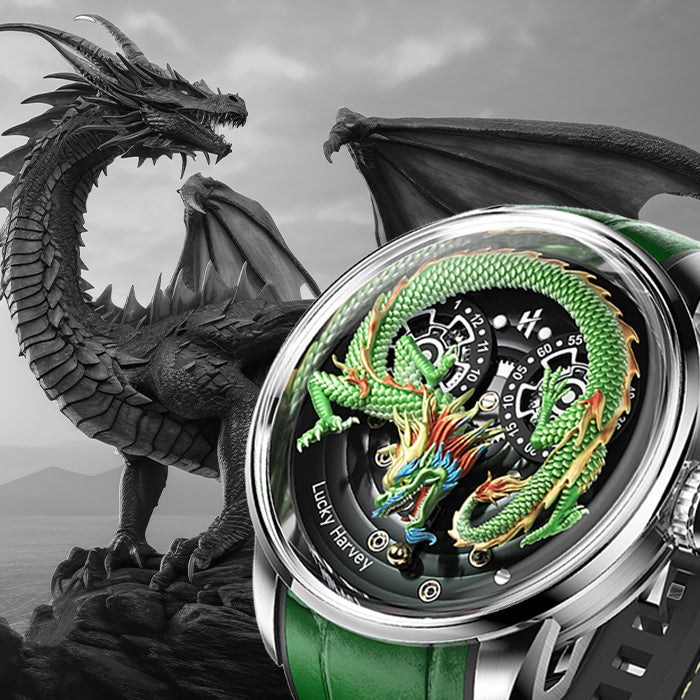
- Green dragon: wood element, growth, vitality. Associated with the Azure Dragon of the east.
Matching the dragon's color to the meaning you want to invoke is not mystical — it is reading the language fluently. A gold dragon on a wedding day is a blessing. A blue dragon at the start of a new venture is an invocation of fresh beginnings.

The Green Dragon — the wood element: growth, vitality, and the Azure Dragon of the east.
Posture and Flight: What the Dragon Is Doing
A dragon in flight signals ascendancy and good fortune rising. A coiled dragon signals latent power, protection, and guardianship. A dragon chasing a flaming pearl — the most traditional motif in Chinese dragon art — signals the eternal pursuit of wisdom and enlightenment. These three postures are the classics, and the best dragon watches pick one deliberately and commit to it rather than mixing them.
The pearl is the detail most buyers miss. In traditional iconography, the dragon is almost always shown reaching toward or holding a flaming pearl, which represents wisdom, the sun, the moon, or pure energy. A dragon watch without a pearl is incomplete in the traditional reading. A dragon watch with a pearl tells a complete cosmic story in a single dial.
Modern Interpretations: What 2026's Dragon Watches Are Doing
The last three years have been a quiet renaissance for dragon watches. As Chinese luxury watchmaking has grown up, dragon motifs have moved from the kitsch-novelty category into serious craft territory, with hand-enameled dials, engraved relief work, and mechanical animation that brings the dragon to life on the dial.
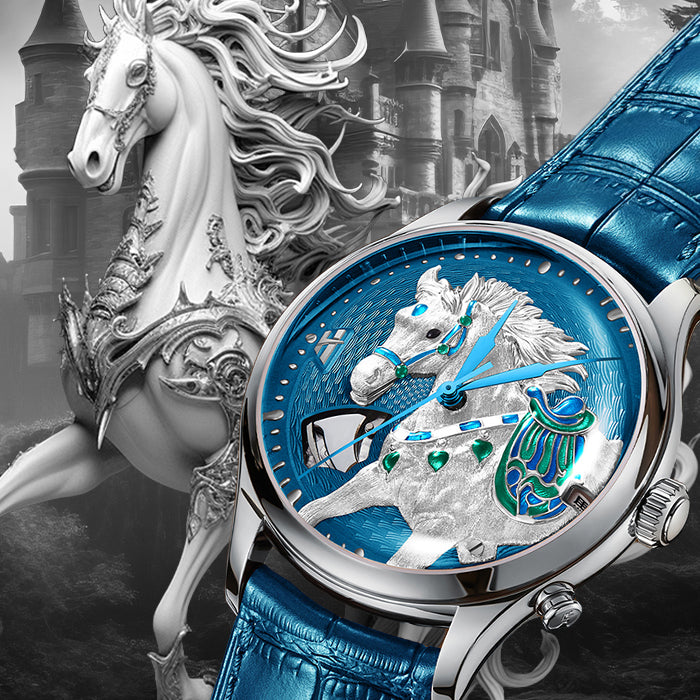
The Lucky Harvey White Dragon automatic is one of the clearest examples of where this category is heading. A five-clawed white dragon rendered in multi-layer relief across the full dial, with the flaming pearl positioned at 12 o'clock and a hand-finished automatic caliber visible through an exhibition caseback. It is not a sticker. It is a piece of dial sculpture, and under a loupe the level of detail in the scales, the claws, and the facial expression is genuinely startling at the $1,899 price point.

The Rose Gold Dragon — sculpted relief dial work with the flaming pearl motif.
Above that price, independent Chinese and Hong Kong makers are pushing into hand-enamel territory with dragon dials in the $5,000 to $15,000 range. The Swiss houses (Jaeger-LeCoultre, Vacheron Constantin, Blancpain) all make dragon editions for the Chinese market, usually as special editions tied to Lunar New Year, with prices starting around $30,000.
How to Wear a Dragon Watch
Dragon watches are statement pieces. Pair them down.
- Silver or white dragon on a navy suit: elegant, intentional, understated. Our favorite pairing.
- Gold dragon on traditional Chinese clothing: the complete cultural reference, especially appropriate at weddings, Lunar New Year, and milestone celebrations.
- Red dragon for celebrations: Lunar New Year, birthdays, anniversaries, weddings. Red dragons want to be seen on happy occasions.
- Avoid: dragon watch plus dragon tie plus dragon cufflinks. One dragon per outfit.

The Silver Dragon — elegant and understated on a navy suit.
Frequently Asked Questions
Is it culturally appropriate for non-Chinese buyers to wear a dragon watch?
Yes — in Chinese tradition, the dragon is a symbol of good fortune to be shared, not a sacred image restricted to one group. Wearing one respectfully, with understanding of what it means, is welcomed.
Which dragon color is most auspicious?
Gold for prosperity and authority. Red for happiness. Blue for new beginnings. There is no single 'most auspicious' — the right color depends on what you want the watch to say.
Are dragon watches a good gift for Lunar New Year?
Exceptionally. A dragon watch given at Lunar New Year carries both the festival association and the lifelong good-fortune symbolism. It is one of the most meaningful watch gifts possible in Chinese tradition.
Does the Year of the Dragon affect value?
Dragon watches released in a Year of the Dragon (the next is 2036) often carry limited-edition status and hold their value better than off-year releases. Collector interest peaks in those years.
Ready to Shop?
Browse the full Dragon Watch Collection on Lucky Harvey — sculpted automaton dials, imperial five-clawed dragons, and limited production runs — or join the Collector's List for early access to new drops, restocks and subscriber-only pricing.
Dragon Watch CollectionCraftsmanship Series